
Understanding Material Science: Hydroph PU vs. Latex-Free Alternatives
In the competitive landscape of cosmetic tools, the raw material defines the end-user experience. For B2B buyers and brand owners, understanding the chemistry behind the sponge is crucial for ensuring product safety and performance. We prioritize materials that meet rigorous international standards, ensuring that every sponge leaving the factory supports your brand’s reputation for quality.
The Dominance of Latex-Free Hydrophilic Polyurethane
Hydrophilic Polyurethane (PU) has established itself as the gold standard in the beauty industry, far surpassing traditional latex options. As a specialized latex-free sponge manufacturer, we utilize this material to eliminate the risk of allergic reactions, making the tools safe for all skin types, including sensitive skin.
The primary advantage of Hydrophilic PU lies in its unique interaction with water. Unlike standard foams, this material is designed to be hydrophilic (water-loving). When wet, the sponge structure expands significantly, becoming softer and more pliable. This physical change prevents the sponge from absorbing expensive liquid cosmetics, ensuring the product sits on top of the sponge for efficient transfer to the skin.
Material Density and Micro-Pore Structure: Impact on Release Rate
The difference between a budget sponge and a premium tool often comes down to density and pore size. Our manufacturing process focuses on creating a high-density structure with a refined micro-pore surface.
- Minimal Product Absorption: A tighter cell structure prevents foundation and concealer from seeping deep into the core of the sponge. This ensures that the user wastes less makeup.
- Flawless Application: High-density foam provides the necessary resistance to buff products into the skin, creating a seamless, airbrushed finish without streaks.
- Durability: Denser materials resist tearing and crumbling during washing, offering a longer lifespan for the consumer.
Eco-Friendly and Bio-Based Innovations in Foam Manufacturing
Modern consumers demand sustainability alongside performance. Sourcing from a responsible OEM makeup sponge partner ensures that production processes align with environmental consciousness. We focus on non-toxic, skin-friendly formulations that prioritize safety and durability. By engineering sponges that maintain their integrity over months of use, we reduce the frequency of replacement and minimize waste. Furthermore, our commitment to high-quality, latex-free materials ensures that the manufacturing process remains cleaner and compliant with global safety standards.
Key Technical Specifications Every Procurement Manager Must Verify
When sourcing cosmetic tools, relying on visual aesthetics alone is a costly mistake. As a manufacturer, I see too many buyers overlook the physical metrics that determine product performance. To ensure you are getting a premium product that builds brand loyalty, you need to validate specific technical benchmarks during the sampling phase.
Shore Hardness and Bounce-Back Memory Testing
The tactile experience of a makeup sponge is defined by its Shore hardness and resilience. We don’t just guess at “softness”; we engineer it. A sponge must be soft enough to feel luxurious on the skin but possess enough structural integrity to rebound instantly after being squeezed.
If the foam density is too low, the sponge creates a patchy application and degrades quickly. If it is too high, it feels like a rock against the face. Through our specialized OEM solutions, we allow brands to calibrate this density to find the perfect balance between plush comfort and precise application control.
Checklist for Resilience:
- Compression Set: Does the sponge return to its original shape immediately after 50% compression?
- Surface Texture: Is the pore structure uniform to prevent streaking?
- Durability: Can it withstand repeated washing without tearing?
Expansion Ratio and Water Retention Analytics
The hallmark of high-quality Hydrophilic Polyurethane is its reaction to water. A superior sponge should expand significantly when wet. This expansion tightens the surface pores, ensuring that makeup sits on top of the sponge rather than being absorbed into the core. This saves the end-user money on foundation and ensures a flawless, airbrushed finish.
We strictly monitor the expansion coefficient to guarantee consistency across every batch.
| Metric | Standard Performance Target | Benefit |
|---|---|---|
| Expansion Factor | 1.5x to 2x original size | Creates a softer, bouncier surface area. |
| Water Retention | High moisture hold, no dripping | Allows for dewy application without mess. |
| Product Absorption | Minimal (<5%) | Prevents wastage of expensive liquid cosmetics. |
Antimicrobial Treatments and Long-term Skin Safety Standards
Safety is the baseline for any cosmetic accessory. We utilize latex-free materials to eliminate the risk of common allergic reactions. However, raw material safety goes deeper than just being “latex-free.” It involves rigorous oversight of the entire production line to prevent contamination.
Our robust supply chain management ensures that every block of raw foam is tested for purity before it enters our molding process. We focus on hypoallergenic properties and resistance to mold growth, which is critical for a tool designed to be used damp. Ensuring these safety standards protects your brand from liability and ensures customer trust.
Evaluating Manufacturer Capability: Beyond the Unit Price
When navigating The Buyer’s Guide to Sourcing Cosmetic Makeup Sponges, it is easy to fixate on the bottom-line cost per unit. However, the cheapest option often becomes the most expensive mistake if the supply chain breaks. We focus on building a partnership that guarantees stability, safety, and scalability for your brand.
Compliance and International Certifications (ISO, GMP, REACH)
Global markets demand strict adherence to safety and management standards. A low quote is useless if your shipment is detained at customs due to chemical non-compliance. We prioritize verifying that all materials meet international regulations, such as REACH for the European market and FDA standards for the US.
It is critical to find a reliable makeup sponge manufacturer that maintains transparent documentation. We ensure our operations align with ISO quality management systems and Good Manufacturing Practices (GMP). This level of compliance protects your brand from liability and ensures the end product is safe for consumer skin.
Lead Times and Production Scalability: From Mold to Mass Market
Your supply chain must be agile enough to handle market fluctuations. Whether you are launching a seasonal collection or restocking a core product line, the factory’s capacity dictates your speed to market. We operate a high-efficiency manufacturing facility designed to scale from prototype to mass production without bottlenecks.
- Mold Creation: Rapid prototyping for custom shapes.
- Volume Flexibility: Handling both Minimum Order Quantities (MOQ) and large-scale global distribution.
- Logistics: Clear timelines for production, packaging, and shipping to prevent stockouts.
Quality Control Standards: Implementing the AQL 0.5% Threshold
Consistency builds brand loyalty. We do not rely on spot checks alone; we implement rigorous inspection protocols at every stage of the manufacturing process. By adhering to strict Acceptable Quality Limits (AQL), often targeting a 0.5% threshold for critical defects, we ensure uniformity.
Every sponge must match the approved “Golden Sample” in terms of:
- Density and Softness: Ensuring the tactile feel remains constant.
- Visual Aesthetics: No air bubbles, color variance, or ragged edges.
- Functional Performance: Consistent expansion ratios when wet.
Customization & Branding: Scaling Your Private Label
In the competitive beauty market, standing out requires more than just a standard product; it demands a unique identity. As a manufacturer, we see firsthand that the most successful brands are those that leverage customization to create a distinct user experience. Moving from stock items to fully customized tools allows you to control the narrative of your product line and offer specific solutions that generic sponges cannot match.
Bespoke Shapes and Ergonomic Product Engineering
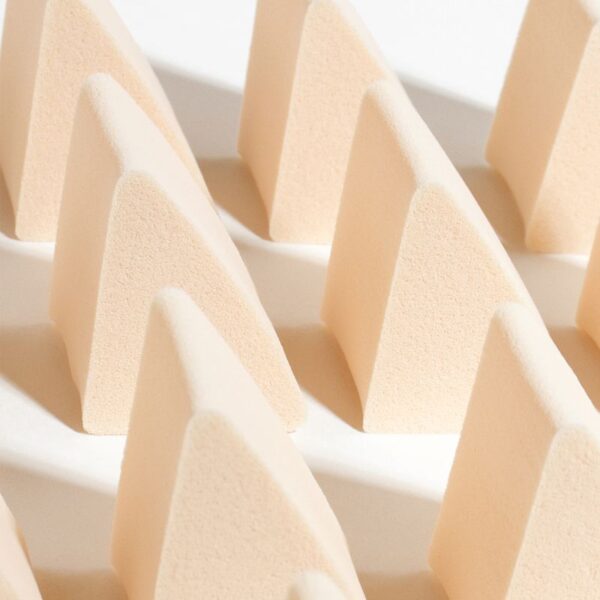
Standard teardrop and gourd shapes are industry staples, but true differentiation comes from ergonomic engineering. We collaborate with brands to design bespoke shapes tailored to specific makeup techniques, such as baking, contouring, or precision concealing. A custom mold does more than look different; it functions differently. For instance, adding a flat edge improves foundation coverage, while a sharper tip enhances detail work around the eyes and nose.
If you are strategizing on how to build a strong brand for your business, developing a signature sponge shape is a powerful move. It transforms a simple accessory into a proprietary tool that customers can only get from you. We handle the technical aspects of mold creation to ensure the foam density works perfectly with your new design.

Advanced Branding Techniques: Laser Etching vs. Silk-Screening
Once the physical design is locked in, applying your logo is the final step in claiming ownership of the product. We primarily utilize two advanced methods for branding cosmetic sponges, each serving a different aesthetic goal:
- Laser Etching: This technique uses a laser to engrave your logo into the foam surface. It creates a debossed, textural effect that is subtle and sophisticated. Since no ink is used, there is zero risk of color fading or chemical interaction with the skin. It is ideal for luxury positioning where longevity is key.
- Silk-Screening: For brands that want their logo to pop, silk-screening applies ink directly onto the sponge. This method offers high visibility and contrast. We use specialized, flexible inks that expand with the sponge when wet to prevent cracking or peeling during use.
Selecting between these methods depends on whether you prioritize high-contrast visibility or a permanent, tactile brand mark.