
Key FDA Regulations and Policies
Navigating the US FDA Compliance Guide for Cosmetic Sponges & Puffs 2026 requires a firm understanding of federal oversight. As a manufacturer or distributor in the global cosmetic industry, staying compliant with current FDA requirements is a non-negotiable foundation for your business.
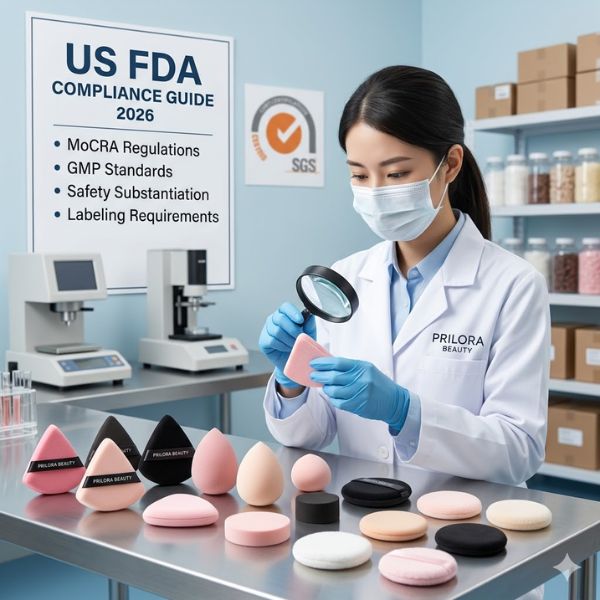
How U.S. Law Defines Cosmetics
Under the Federal Food, Drug, and Cosmetic (FD&C) Act, product classification is strictly determined by its intended use. By law, cosmetics are defined as articles intended to be rubbed, poured, sprinkled, or sprayed on the human body for cleansing, beautifying, promoting attractiveness, or altering the appearance.
Cosmetic sponges and puffs—used specifically for applying foundation, powders, and skincare—fall squarely under cosmetic regulations. It is vital to clearly distinguish these beauty tools from medical devices. If a sponge is marketed to treat acne or heal skin barriers, it crosses the line and risks being classified alongside surgical sponges or hemostatic sponges, which require rigorous medical device protocols.
Are Cosmetic Sponges FDA Approved Before Market?
The definitive answer is no. Cosmetic sponges and puffs do not require formal FDA approval or pre-market FDA clearance before they hit the shelves.
However, this lack of pre-market approval does not mean the sector operates without rules. The FDA exercises strict, aggressive post-market enforcement. While the sponge materials do not need advance clearance, any color additives used to dye the sponges absolutely must be FDA-approved for cosmetic use. Utilizing unapproved dyes immediately violates cosmetic laws and triggers federal action.
General Legal Responsibilities for Manufacturers
As a brand owner or manufacturer, the legal burden of product safety rests entirely on your shoulders. To operate legally and avoid devastating recalls, cosmetic firms must maintain rigorous standards:
- Absolute Safety Substantiation: You are legally obligated to ensure your products do not harm consumers. Selling unsafe cosmetics due to toxic materials or bacterial contamination is a direct violation of federal law.
- MoCRA Compliance: The Modernization of Cosmetics Regulation Act (MoCRA) mandates strict obligations for safety record-keeping, standardizing how brands document the safety of their cosmetic products and materials.
- Zero Tolerance for Violations: You must strictly prevent the distribution of adulterated cosmetics (sponges manufactured in unsanitary conditions or containing hazardous impurities) and misbranded cosmetics (packaging with false, misleading, or legally incomplete labeling).
Compliance must be proactive. Establishing uncompromising quality control from the raw material stage to the final packaged puff is the only way to secure your market position.
Safety Substantiation and Material Testing
When navigating the US FDA Compliance Guide for Cosmetic Sponges & Puffs 2026, proving your items are safe for consumer use is non-negotiable.
Ensuring Material and Product Safety
As a manufacturer, I know firsthand that the safety of your cosmetic products starts directly with your raw materials. You must verify that the foams, pigments, and binding agents used in your products are completely safe for routine skin contact. We rigorously test for skin irritation, toxicity, and microbial contamination. Sourcing reliable cosmetic sponges from trusted partners ensures that the baseline materials already align with strict FDA requirements, keeping your brand out of trouble.
Who is Responsible for Substantiating Safety?
The short answer? You are. The FDA does not grant pre-market FDA approval for makeup applicators. Under the updated MoCRA and the FD&C Act, cosmetic firms carry the full legal burden of safety substantiation.
If you are outsourcing production, partnering with a compliant OEM makeup sponge facility is your best defense. To stay compliant, you must:
- Maintain strict records: Keep all lab tests and safety data sheets readily available.
- Assess physical safety: Ensure the product holds up and does not degrade into unsafe micro-sponge particles during normal use.
- Verify your supply chain: Only work with cosmetic industry partners who follow strict GMP regulation.
Adulterated vs. Misbranded Cosmetic Products
The FDA draws a hard line on both product quality and honesty. It is crucial to understand the distinction between these two violations to avoid product recalls or legal action.
| Violation Type | What It Means | Common Example |
|---|---|---|
| Adulterated Cosmetics | The product contains unsafe, contaminated, or filthy substances. | A blending sponge harboring harmful bacteria or mold due to unsanitary factory conditions. |
| Misbranded Cosmetics | The product labeling is false, misleading, or missing required details. | A puff marketed as “100% natural” with no proof, or missing the distributor’s physical address. |
Labeling Requirements: US FDA Compliance Guide for Cosmetic Sponges & Puffs 2026
Getting your labels right is non-negotiable. If you fail to meet FDA requirements, your cosmetic products instantly become misbranded cosmetics under the FD&C Act. As a manufacturer, I always ensure our packaging is completely transparent, giving consumers exactly the information they need while staying fully compliant with the latest cosmetic regulations.
Mandatory Information on Product Packaging
Every cosmetic sponge needs clear, accurate labeling. Whether you are boxing up a standard applicator or packaging a soft circular makeup sponge, the FDA expects specific, unambiguous details on the outer container.
Key Labeling Elements:
- Identity Statement: Clearly state what the product is (e.g., “Latex-Free Makeup Sponge”).
- Net Quantity: Accurately list the number of items inside the package.
- Material Facts: Disclose primary materials, especially if they interact with cosmetic ingredients.
- Warning Statements: Provide clear usage directions to prevent injury and avoid the classification of unsafe cosmetics.
| Label Element | FDA Location Requirement | Formatting Rule |
|---|---|---|
| Product Identity | Principal Display Panel (PDP) | Bold, prominent, and easy to read |
| Net Contents | Bottom 30% of the PDP | Distinct color contrast from artwork |
| Warnings | Information Panel | Must meet minimum type size regulations |
Guidelines for Natural and Organic Claims
Slapping “organic” or “100% natural” on your packaging without proof is a fast track to regulatory trouble. While the FDA does not have a strict legal definition for “natural” in the cosmetic industry, they aggressively enforce rules against false or misleading claims.
- Organic Verification: The USDA regulates the term “organic” through the National Organic Program. The FDA simply ensures the final product is safe and accurately labeled.
- Truth in Advertising: If you claim your sponges are plant-based or eco-friendly, you must possess the supply chain data to substantiate it. Failing to do so results in misbranded cosmetics.
Proper Distributor and Address Details
Under MoCRA, accountability is stricter than ever for cosmetic firms. Your label must clearly identify exactly who is responsible for placing the product on the market.
- Business Entity: State the legal name of the manufacturer, packer, or distributor.
- Full Address: Include the complete street address, city, state, and zip code.
- Adverse Event Contact: You must display a domestic U.S. phone number, physical address, or specific electronic contact method. Consumers must have a direct line to report adverse health events or issues.
Facility Registration and Product Listing
Mandatory FDA Facility Registration
Under the updated US FDA Compliance Guide for Cosmetic Sponges & Puffs 2026, registering your manufacturing site is no longer optional. Thanks to the Modernization of Cosmetics Regulation Act (MoCRA), all cosmetic firms that manufacture or process cosmetic products for the U.S. market must officially register their physical facilities with the FDA. This is a strict, non-negotiable FDA requirement designed to ensure complete transparency and accountability across the cosmetic industry.
How to List Your Cosmetic Sponge Products
Beyond registering your facility, you must legally list every specific product you intend to sell. I always remind our partners that this product listing must be submitted directly through the FDA’s designated online portal, detailing the specific materials, components, and intended use. Whether you are producing specialized applicators locally or sourcing bulk makeup sponges wholesale for your retail brand, each distinct variant must be actively registered. Failing to keep your product listings accurate and updated violates current cosmetic regulations and can result in your goods being held at the border.
FDA Exemptions for Small Businesses
The FDA does offer specific exemptions to ease the compliance burden on smaller operations. If you run a smaller enterprise, you might be fully exempt from the mandatory facility registration and product listing requirements.
Here is exactly how the small business exemption breaks down:
- Sales Threshold: Your average gross annual sales of cosmetics in the U.S. over the previous three years must fall below $1,000,000.
- Product Exclusions: This exemption is instantly voided if you manufacture products that are injected, intended for internal use, or designed to alter appearance for more than 24 hours. Fortunately, standard makeup sponges and puffs do not trigger these exclusions.
- Safety Standards Remain: Even if your volume qualifies you for a registration exemption, you must still comply with fundamental cosmetic laws. You are always responsible for ensuring your items are completely safe for consumer use and never classified as adulterated cosmetics.
Manufacturing Practices and Ongoing Compliance
Staying compliant isn’t just a one-time setup. In the cosmetic industry, maintaining high standards is an everyday job. We must ensure our cosmetic firms consistently meet FDA requirements to keep unsafe cosmetics out of the market. Under the latest MoCRA updates to the FD&C Act, ongoing compliance is stricter than ever for our US FDA Compliance Guide for Cosmetic Sponges & Puffs 2026.
Good Manufacturing Practices (GMP) Guidelines
Following a strict GMP regulation ensures every makeup sponge we produce is clean, safe, and consistent. The FDA looks closely at our facilities, equipment, and hygiene protocols to enforce current cosmetic regulations.
Key GMP steps we follow:
- Sanitation: Keeping workspaces, storage areas, and equipment completely sterile to avoid contamination.
- Quality Control: Testing all raw materials before they hit the production line.
- Documentation: Tracking every batch of sponges from raw material to the final package.
- Partner Alignment: Ensuring our custom manufacturing solutions always align with these federal safety benchmarks.
Adverse Event Reporting Procedures
If a customer reports a serious health issue—like a severe skin infection or allergic reaction—after using our puffs, we must act immediately. MoCRA makes adverse event reporting a strict legal requirement.
- Log Everything: We record all customer complaints regarding adverse health reactions.
- Report to the FDA: Any serious adverse events must be submitted directly to the FDA within 15 days of receiving the report.
- Retain Records: We keep these medical and complaint records safely on file for at least 3 to 6 years, depending on the size of the operation.
Preparing for Potential FDA Inspections
The FDA has the authority to inspect our manufacturing facilities at any time to verify we are playing by the rules. Being unprepared is a massive risk that can shut down operations.
How we stay inspection-ready:
- Perform Internal Audits: We regularly check our own factory floors for safety gaps before an inspector does.
- Train Staff: Every worker fully understands the hygiene and safety protocols.
- Organize Paperwork: We keep our product listings, GMP logs, and adverse event reports centralized and easily accessible so we can hand them over without delay.
 English
  French (France)
  French (Canada)
  Japanese
  Korean
  German
  Italian
  Spanish
  Arabic
  Dutch
Dutch